
Judgement Kills Confidence: How to Stop Judging Yourself and Others
Judgement kills confidence — yours and theirs.
When we talk about how to build confidence, we often focus on what we need to add: better skills, more preparation, more experience, more positive thinking.
But sometimes building confidence is also about what we need to let go of.
And one of those things is judgement.
There are two sides to judgement that can quietly undermine our confidence: the way we judge ourselves and the way we judge other people.
Both matter more than we might realise.
1. Self-Judgement Shrinks Your Confidence
Most of us know what it feels like to have an overactive inner critic.
You finish a presentation and immediately think:
I talked too fast.
I should have answered that question better.
Why did I say that?
Everyone else sounded more confident than me.
A little self-reflection is useful. It helps us learn and improve.
But self-reflection and self-judgement are not the same thing.
Self-reflection asks: What can I learn from this?
Self-judgement says: I wasn’t good enough.
And when that becomes our default response, it can have a huge impact on our confidence.
I see this regularly in my work as a public speaking and communication coach. People can give a perfectly good presentation and still walk away focusing almost entirely on the one thing they didn’t do perfectly.
Over time, that harsh self-talk teaches us to doubt ourselves.
Instead of thinking, I can handle this, we start thinking, What if I get it wrong?
And that can show up everywhere — presentations, meetings, difficult conversations, networking, leadership and even simply speaking up when we have something valuable to contribute.
If you want to build genuine confidence, learning to manage your inner critic is an important place to start.
2. Fear of Being Judged Can Hold Us Back
One of the biggest barriers to public speaking confidence is the fear of judgement.
What will they think of me?
What if I make a mistake?
What if I don’t sound smart enough?
What if they can see that I’m nervous?
When we’re focused on how other people might be judging us, our attention turns inward.
Instead of concentrating on our message and connecting with the people in front of us, we’re monitoring ourselves.
How do I look?
How do I sound?
What are they thinking?
That’s exhausting — and it makes confident communication much harder.
Confidence grows when we stop monitoring ourselves so closely and start focusing on the people we’re there to communicate with.
But there’s another side to this that I think is worth considering.
3. How Much Are You Judging Other People?
Here’s the slightly uncomfortable question:
If you’re terrified that other people are judging you, how much are you judging them?
As a speaking coach, I’ve noticed something interesting over the years.
Sometimes the people who are most paralysed by what an audience might think of them are also pretty tough critics when they’re sitting in the audience themselves.
We notice someone’s nerves.
We decide someone isn’t engaging.
We critique the way they speak.
We make assumptions based on their body language.
And if that’s what we do when we’re watching other people, it’s hardly surprising that we assume everyone else is doing exactly the same thing to us.
Judging others can reinforce our own fear of being judged — and that can quietly undermine our confidence.
I learnt that lesson myself.
The Participant I Completely Misjudged
Years ago, I was running a two-day training program.
One participant sat through much of the course with his arms crossed. He gave me very little eye contact. There was some huffing and puffing.
From where I was standing, his body language was telling me one thing:
He did not want to be there.
I judged him as disengaged.
In fact, I was surprised when he came back for day two. I’d half expected him to develop a sudden case of food poisoning to escape!
At the end of the program, I asked him what he’d thought of the training.
His answer completely surprised me.
He’d loved it.
He’d been listening and taking it all in the entire time.
I had read his body language and created a story around it.
And I was wrong.
Read the Room. Don’t Judge the Room.
That experience taught me something I’ve carried into every training room since.
Read the room, yes. But don’t judge the room.
As a presenter, facilitator or leader, you absolutely need to pay attention to the people around you.
Are they following you?
Do you need to explain something differently?
Is the energy dropping?
Do you need to ask a question, change pace or bring people back into the conversation?
That’s reading the room.
Judging the room is different.
They’re bored.
They don’t like me.
She’s difficult.
He’s not interested.
Those are interpretations — and they aren’t necessarily facts.
The danger is that once we believe the story we’ve created, our own behaviour starts to change.
We become less confident.
We rush.
We over-explain.
We try too hard to win people over.
Or we retreat.
Instead of being present, we’re performing in response to a judgement that may not even be true.
How to Build Confidence Without Judgement
So, how do we stop judgement from undermining our confidence?
Start by becoming curious rather than critical.
When you notice your inner critic taking over after a presentation or meeting, replace “I was terrible” with:
What went well? What would I do differently next time?
When you’re worried about what an audience is thinking, bring your attention back to your purpose:
What do these people need from me right now?
And when you catch yourself judging someone else, challenge the story you’ve created:
What else could be true?
That person with their arms crossed might be disengaged.
Or they might be concentrating.
The person who isn’t making eye contact might be uninterested.
Or they might be nervous themselves.
We rarely have the complete picture.
Drop the Judgement and Grow Your Confidence
Confidence doesn’t come from never making mistakes or having everyone approve of you.
It comes from learning to trust yourself even when things aren’t perfect.
And when it comes to public speaking and communication, confidence grows when we stop monitoring ourselves so closely and start focusing on the people we’re there to communicate with.
So give yourself permission to reflect without tearing yourself apart.
Give other people permission to show up differently from you.
And the next time you’re presenting, speaking in a meeting or standing in front of a room, remember:
Read the room. Don’t judge the room.
Because the less energy you spend judging yourself — and everyone else — the more space you create for confidence.
Want to Build Greater Confidence?
I work with individuals and teams to develop practical public speaking and communication skills that help people feel more confident, clear and credible when it matters.
Get in touch to find out how I can support you or your team.
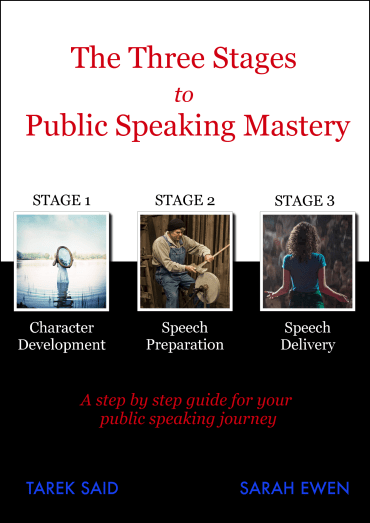
Start getting better at public speaking today!
We distilled the art of public speaking into three concise and easy to read chapters: Character Development, Speech Preparation and Speech Delivery.
If you want to overcome your fear of public speaking, learn how to write engaging speeches and read about the speech delivery concepts then this book is for you. Start getting better at public speaking by clicking the button below.