
3 Proven Ways to Build Confidence and Stop Comparing Yourself
Ever felt good about your progress… until you saw someone else’s LinkedIn update?
A promotion. A new client. A speaking opportunity. Suddenly, what you were pleased about five minutes ago doesn’t feel like enough.
I’ve done it too. Looking sideways at colleagues, competitors and even friends. Measuring myself against their best, then wondering why my confidence had taken a hit.
Perhaps you recognize it with public speaking. You deliver a presentation you’re proud of, then watch a polished colleague and immediately start picking yours apart.
Yet your presentation hasn’t changed. You’ve just changed the measuring stick.
Someone else’s success doesn’t erase your progress.
That’s a reminder I’ve needed myself. If you want to stop comparing yourself to others and build confidence, start by giving your own progress more attention.
Why comparison can knock your confidence
When you look sideways, you rarely have the full picture.
You see someone’s polished presentation, but not the hours of practice. You hear about their promotion, but not the setbacks along the way.
Meanwhile, you know every wobble, doubt and unfinished task in your own life.
It’s an uneven comparison.
For more on this, the Victorian Government’s Better Health Channel guide to self-esteem also recommends avoiding comparisons with others and recognizing your own qualities.
Learning from other people can be useful. For example, watching a strong speaker might give you an idea for opening your next presentation or making a complex point clearer.
However, the trouble starts when “What could I learn from them?” becomes “Why am I not as good?”
That’s when someone else’s achievement starts overshadowing your own.
Three ways to stop comparing yourself to others and build confidence
1. Get clear on your own goal
What do you actually want to improve?
“Be more confident” is a starting point. Now give yourself something specific to work towards.
Perhaps you want to:
- Contribute an idea in your next team meeting.
- Deliver a presentation without reading every word from your notes.
- Have a conversation you’ve been putting off.
- Answer an unexpected question without apologizing first.
Choose something that matters to you and fits where you are now.
For example, if your goal is to speak up once in a meeting, doing that is progress — even if the person beside you confidently leads the whole discussion.
2. Roll up your sleeves and practice
Once you’ve chosen your goal, identify one action you can take.
Want to feel more confident presenting? Practice your opening aloud.
Want to contribute more in meetings? Prepare a point beforehand and look for an opportunity to share it.
You don’t have to wait until you feel completely ready. Instead, give yourself opportunities to practice, get feedback and try again.
Each attempt gives you experience to draw on. Over time, you collect evidence that you can speak up, handle a challenge and improve.
3. Check your step count
We’re often so busy looking at how far we have to go that we forget to notice how far we’ve come.
After a meeting, presentation or challenging conversation, ask yourself:
- What did I do well?
- What felt easier than it used to?
- What will I practice next time?
Perhaps you still felt nervous, but you made your point clearly. Perhaps you lost your place, recovered and kept going.
Those moments count.
That’s why it helps to write them down. Otherwise, it’s surprisingly easy to overlook your progress while focusing on the next thing you want to improve.
How leaders can build confidence in their teams
As leaders, we’ve got to pay attention to this too.
Think about how you recognize achievement. Do you regularly compare people with your strongest performer? Or do you also acknowledge individual improvement?
A quieter team member speaking up may represent significant progress. So might someone volunteering to present or handling a difficult conversation more effectively.
You can maintain clear expectations while recognizing that people have different starting points.
For example, make your feedback specific: “Your recommendation was clear, and you gave us exactly the information we needed to make a decision.”
That gives someone useful evidence of what’s working — and something they can build on.
Encourage people to learn from one another and recognize their own progress along the way.
Give your own progress some credit
The next time you catch yourself looking sideways, ask:
“Am I learning something useful, or just giving myself a hard time?”
Then return to your own goal and the next action you can take.
Let’s save competing with the person next to us for the egg and spoon race. 🥚🥄
Before you move on, write down one thing you can do now that you found difficult six months ago.
It might be speaking up, handling a tough question or simply saying yes to an opportunity you once would have avoided.
Give yourself some credit for that.
Want support to build your speaking confidence? My one-to-one public speaking coaching gives you space to practice, get feedback and work towards your own communication goals.
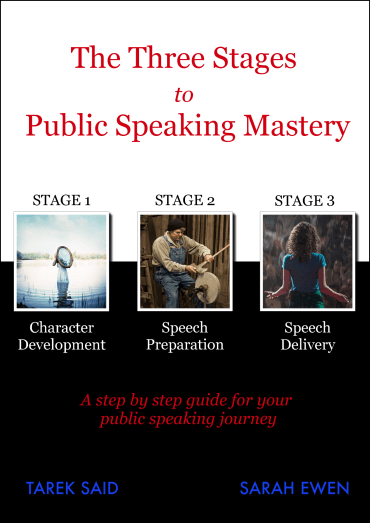
Start getting better at public speaking today!
We distilled the art of public speaking into three concise and easy to read chapters: Character Development, Speech Preparation and Speech Delivery.
If you want to overcome your fear of public speaking, learn how to write engaging speeches and read about the speech delivery concepts then this book is for you. Start getting better at public speaking by clicking the button below.