
How to Build Confidence at Work When Everything Around You Is Changing
Change and uncertainty can have a significant impact on confidence at work.
A restructure. A new leader. Increased expectations. A change in role. A difficult piece of feedback. A period of uncertainty about what comes next.
When the environment around us changes, it can be surprising how quickly we begin to question ourselves.
So how do you build confidence at work when the circumstances around you feel anything but certain?
I believe part of the answer lies in understanding where your confidence is coming from in the first place.
Are you building confidence from the outside in?
It’s easy to feel confident when things are going well.
You’re performing well. People value your contribution. You feel secure in your role. You know what is expected of you. Perhaps you’ve recently achieved something you’re proud of.
All of these things can give our confidence a boost.
The problem is that they are external.
And external circumstances can change.
If our confidence becomes too dependent on everything around us going well, what happens when it doesn’t?
That’s what I think of as outside-in confidence.
It can feel strong when circumstances are favourable, but it can become much more difficult to sustain when we’re facing change, pressure or uncertainty.
What does inside-out confidence look like?
Inside-out confidence doesn’t mean being endlessly positive or never doubting yourself.
And it certainly doesn’t mean believing you’re going to succeed at everything you do.
It’s much more grounded than that.
It’s about developing greater trust in your ability to deal with what comes your way — even when you don’t know exactly how things are going to turn out.
That distinction becomes particularly important during challenging periods at work.
You may not be able to control a restructure.
You may not be able to control a decision made by senior leadership.
You may not be able to control whether somebody agrees with your idea, how a presentation will be received or whether you get the opportunity you put yourself forward for.
But those things don’t have to have complete control over your confidence either.
One of my biggest lessons about confidence
I learnt this in a fairly unexpected way early in my own career.
In 2007, just months after my second brain surgery, I was “voluntold” to represent my team in a national-level company debate.
My physical confidence at the time wasn’t exactly soaring.
I had a bald patch at the front of my head, a puffy face and a bandana.
But I decided to step up and do it anyway.
That decision ended up becoming a pivotal moment in my career.
The debate gave me exposure within the organisation that my technical skills alone hadn’t. It opened doors and, perhaps most significantly, sparked my love of public speaking — something that would eventually lead me to start my own business.
But here’s the part I find most interesting when I look back.
I didn’t take the opportunity because I felt confident.
I took the opportunity despite not feeling particularly confident.
Do you need confidence before you take action?
We often think confidence needs to come first.
I’ll speak up when I’m more confident.
I’ll go for the promotion when I feel ready.
I’ll present when I’m less nervous.
I’ll have that conversation once I know exactly what to say.
But sometimes waiting for confidence can keep us stuck.
Taking action — even a relatively small action — gives us new information about ourselves.
We discover that we survived the difficult conversation.
That we could answer the unexpected question.
That our idea was worth contributing.
That being nervous didn’t stop us from presenting effectively.
That we could cope with being outside our comfort zone.
Those experiences become evidence.
And that evidence can gradually change what we believe we’re capable of.
Why confidence matters during workplace change
This is particularly relevant in workplaces right now.
Change has become a normal part of organisational life. Teams evolve, technology changes how we work, expectations shift and people are regularly being asked to adapt.
Organisations can’t remove all of that uncertainty.
Nor should the goal be to make employees feel confident every minute of every day.
A more useful question might be:
How can we help people feel better equipped to navigate uncertainty when it comes?
Because confidence isn’t only valuable when someone is standing on a stage.
It affects whether people contribute ideas.
Whether they ask questions.
Whether they speak up in meetings.
Whether they put themselves forward.
Whether they have difficult conversations.
And whether they are prepared to take the next step when they can’t be completely certain of the outcome.
You don’t have to wait for the environment to change
If your confidence has taken a hit recently, it can be tempting to focus on everything that needs to change around you before you’ll feel like yourself again.
Sometimes those external changes are genuinely needed.
But it’s also worth asking:
What can I strengthen within myself while the external environment is still uncertain?
You don’t need to have every answer.
You don’t need to eliminate every nervous thought.
And you don’t need to wait until circumstances are perfect.
Sometimes building confidence starts with deciding that, even though you can’t control everything around you, you’re willing to back yourself for the next step.
That’s confidence built from the inside out.
Helping teams build confidence from the inside out
This idea is at the heart of my Keys to Confidence keynote.
It’s an interactive session designed to help people explore how they can build more grounded, resilient confidence — particularly when navigating pressure, change and uncertainty.
Because we can’t always make the external environment predictable.
But we can help people become better equipped to navigate it.
If you’re looking at ways to support confidence within your organisation or team, get in touch to find out more about Keys to Confidence.
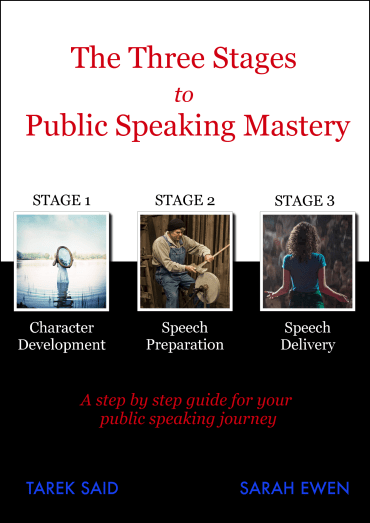
Start getting better at public speaking today!
We distilled the art of public speaking into three concise and easy to read chapters: Character Development, Speech Preparation and Speech Delivery.
If you want to overcome your fear of public speaking, learn how to write engaging speeches and read about the speech delivery concepts then this book is for you. Start getting better at public speaking by clicking the button below.