
How to Build Confidence: One Thought at a Time
Confidence isn’t magic. And it isn’t reserved for people who seem naturally comfortable speaking up.
If you’re wondering how to build confidence — in meetings, presentations or everyday conversations — one place to start is with the way you respond to your thoughts.
Preparation and practice matter. So does the conversation happening inside your head.
Do you manage your mind, or does it manage you?
Thoughts will always pop up.
The inbox assassin who always CCs the world does it again. Boom — thought triggered.
Why have they copied everyone in? Have I done something wrong? What will people think?
Before you know it, one email has become a whole story about your competence.
Here’s what changed things for me: I realised that having a thought doesn’t mean I have to believe it.
I think of it like this: my mind’s got a bouncer.
When a thought shows up, I ask:
“Is this thought helpful and fair? Will it help me move forward, or drag me down?”
I can’t control every thought that arrives. But I can practise choosing how I respond.
That small shift has made a huge difference.
What a strawberry taught me about self-awareness
My first step into all this was, strangely enough, a strawberry.
Years ago, I signed up for a mindfulness session at work. It was free — and Scots love free things.
The exercise? Smell the strawberry. Touch the strawberry. Taste the strawberry.
By the end of the session, I had a mushy red mess in my hand, 60 minutes of my life gone, and I felt irritated — not exactly “present”.
Meanwhile, my colleague walked out saying, “I feel amazing!”
Same session. Two completely different experiences.
That was my wake-up call: I needed to find an approach that worked for me.
For me, that meant learning to notice my thoughts, question the stories I was telling myself, and choose a more useful response.
Can you train your brain to respond differently?
That’s when I discovered neuroplasticity: the brain’s ability to change and adapt through learning and experience. BrainFacts, an initiative of the Society for Neuroscience, explains this in How Experience Shapes Your Brain.
What interested me was the possibility of change. My familiar ways of responding didn’t have to be my only ways of responding.
That doesn’t mean every positive thought instantly rewires your brain or that you can think your way out of every challenge.
For me, the useful lesson was simpler: I could practise responding differently.
Instead of automatically accepting “I’m terrible at presenting”, I could ask:
“What specifically do I need to improve, and what can I practise?”
That gives me somewhere to go.
How to build confidence with more helpful self-talk
You don’t need to pretend everything is wonderful. Start with a response that is believable and useful.
Try these three steps before your next meeting or presentation.
1. Notice the thought
Catch the sentence running through your head.
“Everyone will think I don’t know what I’m talking about.”
2. Question the story
Ask yourself:
- What evidence do I actually have?
- Am I treating a prediction as a fact?
- What would I say to someone else in this situation?
3. Choose a helpful thought — and take action
Try replacing the prediction with something you can act on:
“I’ve prepared. I don’t need to know everything. I can explain what I know and follow up on anything else.”
Then take one small step: ask the question, share your opinion, or practise your opening out loud.
You’re giving yourself an opportunity to learn what you can do.
Confidence is built through thoughts and practice
You don’t have to wait until you feel completely confident to speak up.
You can start by noticing one unhelpful thought, choosing a fairer response, and taking one small action.
Confidence isn’t a fixed quality you either have or don’t have. It’s something you can build.
Thought by thought. Practice by practice.
Want to feel more confident in meetings and presentations? Explore my one-to-one public speaking coaching and get in touch to discuss how we could work together.
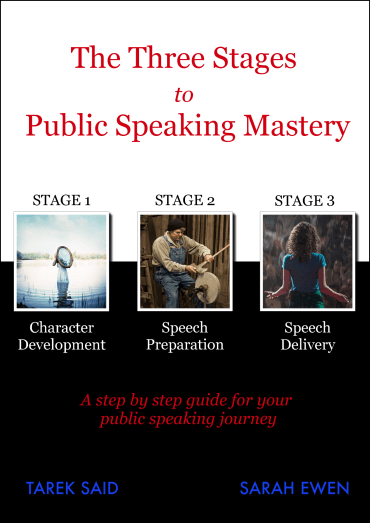
Start getting better at public speaking today!
We distilled the art of public speaking into three concise and easy to read chapters: Character Development, Speech Preparation and Speech Delivery.
If you want to overcome your fear of public speaking, learn how to write engaging speeches and read about the speech delivery concepts then this book is for you. Start getting better at public speaking by clicking the button below.